
Photography · Madeira
The golden coast: Madeira's best sunset photography, chosen by season
The spot never changes; the light does. Golden hour here can be a clean sea of cloud or a washed-out haze, and the window is short. Knowing where to stand is the easy part.
Madeira's sunset question is not where, it is when-plus-where. The setting sun swings across a wide arc through the year, from west-southwest in winter to west-northwest in June, and each classic spot has a season when the geometry works and months when it quietly does not. Match the spot to the calendar and the sky does the rest.
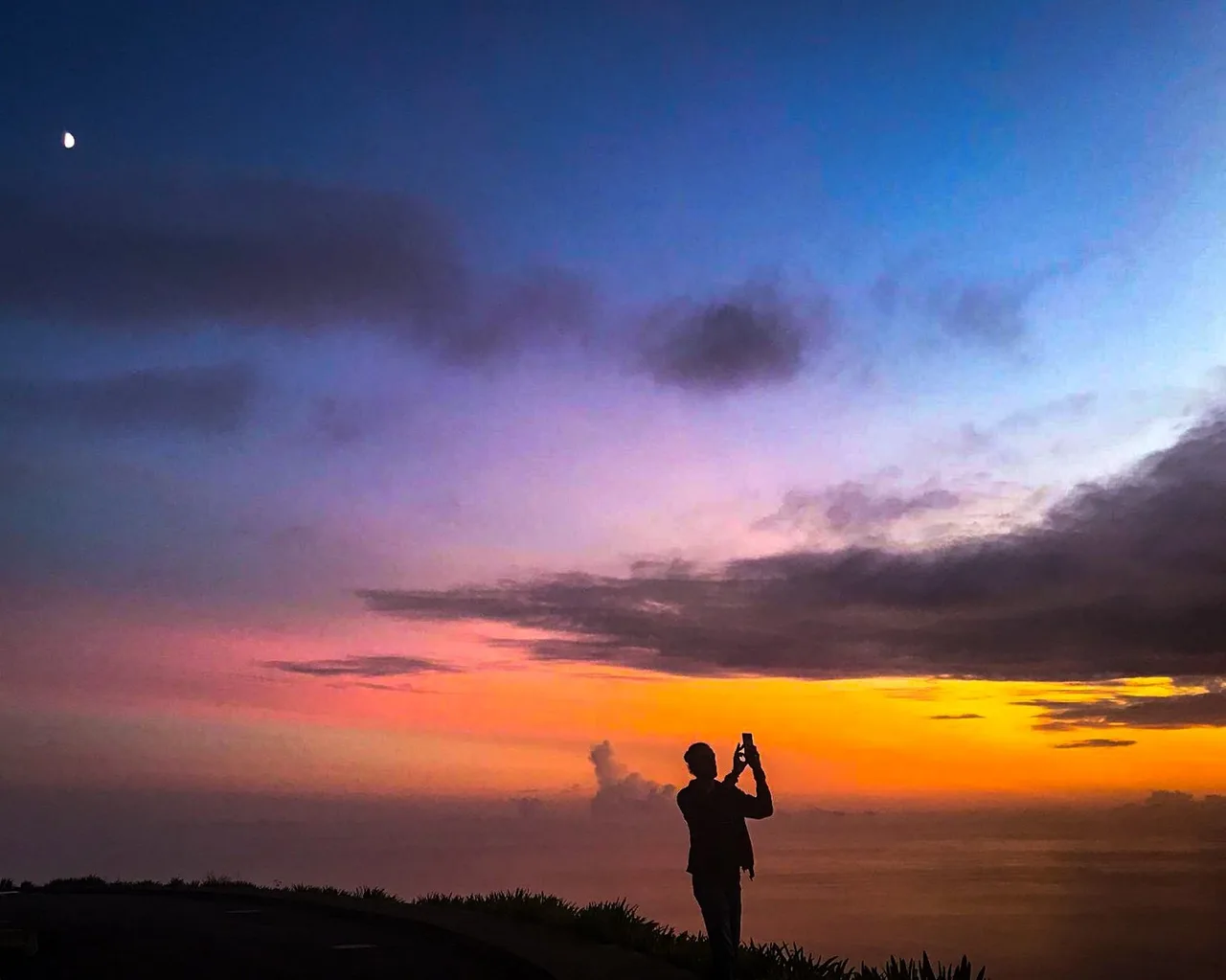
A representative shot of this spot: conditions change day to day.
Live match for this shot
Algorithmic forecast from live data. A high match is a good bet, not a promise.
Ponta do Pargo: the year-round bet
The 1922 lighthouse on the island's westernmost cliff top faces open ocean toward the sunset in every season, which makes it the safe call whenever the sky promises colour. Parking is easy, the coastal paths give multiple angles along the 300-metre cliffs, and the wind is a permanent collaborator: plan silhouettes against the sky and hold the tripod. It is also blissfully uncrowded compared with the south-coast icons.
Cabo Girão: drama with a ticket
The glass skywalk 580 metres over the fajãs is a view first and a composition second, and since January 2026 it costs five euros for visitors over twelve, with official hours of 08:00 to 20:00. In the warm half of the year the sun sets behind the western headlands rather than over water, so the skywalk's sunset season is autumn to spring, and the last entry hour conveniently matches the light. Coach groups thin out late; the glass floor shots need patience or an early morning instead.
Ponta do Sol: the minimalist frame
Officially the sunniest parish on the island, Ponta do Sol contributes the 1849 basalt pier with its round arch, the cleanest minimalist subject on the south coast. A neutral density filter, thirty seconds to two minutes, smoothed water and the arch floating in it: that is the shot, and winter swell only improves the mood. The village behind has dinner waiting, which is not nothing after a long exposure session runs past blue hour.
Wherever you shoot, the live coastal conditions decide the evening: cloud on the west horizon kills Ponta do Pargo while lighting Cabo Girão's cliff face pink, and the match widget above reads exactly that trade-off.
The solar eclipse of 12 August 2026, seen from Madeira
On Wednesday 12 August 2026 the moon passes in front of the sun over the North Atlantic. The centre line, where the eclipse is total, runs far to the north across Greenland, Iceland and northern Spain, so Madeira is not in it. What the island gets instead is a deep partial eclipse in the last two hours of daylight, with the sun already low over the ocean. That combination is unusual and it is the whole reason this is worth planning around rather than just noticing.
Times, and how much of the sun disappears
From Funchal the partial phase runs from 18:49 to 20:41 Madeira time, with maximum at 19:46. At that maximum the moon covers 81.5% of the sun's diameter and 77.4% of its visible disc. Sunset is at 20:57, so the eclipse finishes a quarter of an hour before the sun goes down, and the whole thing happens in daylight. Times shift by a minute or so between the east and west ends of the island, which is well inside the accuracy you need. Sources: timeanddate.com for the times and the magnitude, theskylive.com for the obscuration, both local circumstances for Funchal.
Low in the west-north-west, not overhead
This is the part that decides everything else. The sun is 25 degrees above the horizon when the moon first touches it, 13.6 degrees at maximum on a bearing of 279 degrees, and only 2.3 degrees at last contact on 286 degrees. So you are not looking up, you are looking out to sea, into the last slice of sky above the western horizon. A sun 13 degrees up is shining through several times the depth of air a midday sun crosses, which is why a low bank of cloud or a haze layer that would be invisible at noon can erase the entire event.
Where to stand: it comes down to which coast
Maximum, at 19:46, is generous. At 13.6 degrees the sun clears most of the island's own skyline, so anything with an open view to the west-north-west works, high interior included. Of the 111 trails we have a terrain aspect for, 34 sit within 50 degrees of that bearing, which gives you a sense of how much of Madeira faces the right way.
The final half hour is a different problem. Below about five degrees the sun drops behind whatever land stands between you and the Atlantic, so last contact belongs to the places that hold a true sea horizon on the western side. Which of them is worth the drive is not a map question. It is a weather question, and it can only be answered on the evening itself.
What the weather has to do, and why it is not a safe bet
Madeira does not have one sky. The north coast and the south coast routinely run different weather at the same hour, and in August the two things that spoil a low western sun are a marine stratus deck parked off the coast and Saharan dust blowing in from the south-east. Either can leave the interior in full sun while the horizon you actually need is a grey wall. This is the ordinary case here, not bad luck.
That is what the app is for on this date. The moment exists on 12 August only and enters the forecast three days ahead, so from 9 August a pass carries the live match, the exact window, and the viewpoint to drive to with the route from where you are. What stays free is everything on this page: the times, the geometry, and what the light will do.
Photographing a 77% eclipse low over the sea
A partial eclipse near the horizon is a friendlier subject than a total one. There is no corona to expose for and no sudden darkness to catch you out, and the sun sits in the same part of the sky you would be shooting for a normal Madeira sunset. What it does demand is a filter, because 28% of the sun is still far more light than a sensor or an eye can take.
Filters, and why a phone alone will not do it
You need a proper solar filter over the FRONT of the lens, not a neutral density filter and not a stack of them: an ND filter cuts visible light while letting infrared through, which is exactly how sensors and retinas get damaged. A certified solar film sheet taped over the lens hood works and costs very little. With one on, start around ISO 100, f/8 and 1/250, then bracket wide, because filter densities vary a lot. A phone will not resolve the crescent at any useful size, but holding a pair of eclipse glasses flat against the phone lens does produce a recognisable orange crescent, which is a fair souvenir shot.
Framing: put Madeira in the picture
A 400mm crop of an orange crescent looks the same taken from anywhere on Earth. The frame worth carrying home is the one that could only have been made here: the crescent over a west-coast ridgeline, or above one of the lighthouses on the western cliffs, with a long lens compressing the two together. Shoot the ground scene separately without the filter and combine later if you want both exposed properly, and say that you did. There is also a free effect that costs nothing to catch: during the partial phase every small gap acts as a pinhole, so the shade under a laurel canopy or the light through a kitchen colander fills with dozens of small crescents.
Eye safety, the part with no second chance
Use eclipse glasses certified to ISO 12312-2 and nothing else. Sunglasses, smoked glass, exposed film and welding glass below shade 14 are all useless here. Never look through binoculars, a telescope or a camera viewfinder while wearing eclipse glasses, because the optics concentrate the light and burn straight through the filter. The retina has no pain receptors, so a 77% eclipsed sun feels comfortable enough to stare at while it is doing permanent damage, and the harm shows up hours later. If you only take one thing from this page, take that one.
The times are fixed and public. Whether the western sky is clear that evening is not, and with the sun this low it is the only thing that decides what you see. The pass scores the coast three days out.Trailheads for this shoot: Caminho Real do Paul do Mar (PR19), Levada Nova / Levada do Moinho (PR-LN), Lombada da Ponta do Sol (V-LOMBADA). Visiting rather than shooting? Read the place guide. Also on the calendar: the solar eclipse of 2 August 2027 puts the sun in the east instead of the west, and covers far more of it.
Common questions
Where does the sun set over the sea in Madeira?
From the west tip at Ponta do Pargo, essentially all year. From the south coast, including Cabo Girão and Ponta do Sol, the over-water sunset works from roughly autumn to spring; in high summer the sun drops behind the island's western headlands instead.
Is the green flash visible from Madeira?
On clear, haze-free evenings with a sharp sea horizon, yes, occasionally. The west coast gives the cleanest horizon line. It lasts a second or two at the final sliver of sun, so a long lens already framed and focused is the only way to catch it deliberately.
Will the solar eclipse of 12 August 2026 be visible from Madeira?
Yes, as a deep partial eclipse. Madeira is south of the path of totality, which crosses Iceland and northern Spain, so there is no total phase here. From Funchal the partial runs 18:49 to 20:41 local time with maximum at 19:46, when 77.4% of the sun's disc is covered. The sun is low in the west-north-west throughout, so you need an open view towards the sea rather than a view of the sky overhead.
Where is the best place in Madeira to watch the 2026 eclipse?
It depends on the evening, and that is not evasion. For maximum at 19:46 any open west-north-west view will do. For the final half hour you need a true sea horizon on the western side of the island. Which of those places is actually clear changes hour by hour, because the north and south coasts run different weather at the same moment, so the useful answer is a ranking made on the day, not a list made in advance. The app makes that call and names the one to drive to.
Will it get dark during the eclipse in Madeira?
No. At 77% coverage the light drops and cools noticeably, shadows go strangely sharp and the whole scene turns slightly metallic, but it stays firmly daylight and no stars appear. The change is easy to feel if you are watching for it and easy to miss if you are not. It is nothing like the sudden night of a total eclipse, which is why the coverage figure matters: 77% is a striking sky, not a dark one.
More photography guides: Fanal fog · Pico do Arieiro sunrise · Seixal black sand · Ribeira da Janela stacks · Milky Way in Madeira · Miradouro do Guindaste sunrise
Understand the island's light: microclimate guide · weather by month